How Much Weight Can a Flitch Beam Support
A flitch beam (or flitched axle) is a chemical compound beam used in the structure of houses, decks, and other primarily wood-frame structures. Typically, the flitch beam is made upwardly of a vertical steel plate sandwiched between two forest beams, the iii layers being held together with bolts. In that common course it is sometimes referenced every bit a steel flitch beam. Further alternating layers of wood and steel can be used to produce an even stronger axle. The metal plates within the axle are known as flitch plates.[one] Flitch beams were used every bit a cost-effective way to strengthen long-span wooden beams, and accept been largely supplanted by more recent technology.
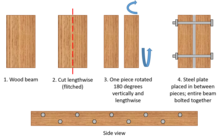
Visual description of how a flitch beam is synthetic
History [edit]
"Flitch" originally referred to a slab of bacon, which was cut into strips lengthwise.[1] Similarly, a wooden beam was flitched by cutting it lengthwise; one one-half was and so rotated 180 degrees both longitudinally and laterally to ensure that any defects were separated. In the 18th century, before the availability of steel beams, pine beams were flitched with hardwood such as oak.[2]
With the availability of affordable steel, flitch beams became a way to strengthen long-span wooden beams cost-effectively while taking up less space than solid wood. An 1883 article from The American Architect and Building News compares 3 alternatives in a hypothetical railway station "in which the second story is devoted to offices, and where we must use girders to support the second floor of 25-foot span, and not less than 12 anxiety on centres if we can avoid information technology. This would give us, to be supported by the girder, a floor area of 12' x 25' = 300 square feet"[3] and 31,500 pounds of load. After performing calculations the beams compare as follows:
| Axle Material | Size | Cost |
| Pino | 14" x 17" | $25.75 |
| Iron | Two 12" girders | $83.32 |
| Flitch-plate | 12" 10 14" | $seventy.seventy |
The article also cites the fire-retardant character of the flitch beam, "in instance of a burn down would not probably touch the iron until the wooden beams were desperately burned."[3]
With the appearance of high-force engineered lumber, the advantages of flitch-beams disappeared. For case, comparing the capacity of two beams spanning xviii anxiety:
| Axle Composition | Allowable Applied Load In Pounds Per Linear Foot |
| three½ʺ × 11¼ʺ laminated veneer lumber (LVL) fellow member | 398 |
| 2 × 12 flitch beam constructed of ½ʺ steel plate with two laminations of #2 SPF | 386 |
Additionally, use of this type of beam has greatly declined due to the high cost of labor. Engineered lumber tin be cut to length and installed much like sawn lumber; the flitch requires shop fabrication and/or field bolting. This, coupled with a much increased self-weight of the beam (11.4 pounds (5.2 kg) for engineered wood vs. 25.2 pounds (eleven.4 kg) for a flitch beam), decreases the viability of the system.
Mod uses [edit]
Flitch beams are currently mainly used in historic renovations, where they can be used to reinforce anile lumber supports, or for aesthetic purposes, where exposed beams with the appearance of forest and the strength of steel are required. An adaptive employ project in the United kingdom, irresolute stables into offices, required cutting the axle supporting a floor down its unabridged length, and so inserting a similarly sized steel plate. The resulting flitched beam was so secured with resin and bolts, preserving appearance while providing force. Flitch beams were used equally columns in a two-story new construction. Glulam beams were used to support the 2nd flooring and the roof. This allowed the advent of wooden columns, while providing the necessary strength.[2]
The method for calculating the size of a flitch beam to be used in construction is straightforward, using the transformed-section method. The steel piece of the beams is imagined to be an equivalently flexible (although much thicker) slice of forest. This allows the elasticity of the entire beam to be calculated as if it were entirely made up of forest.[4] [five] [6]

Visual description of how the forcefulness of a flitch beam is measured
At that place is small-scale business organisation activity involving flitch beams with The Timber Enquiry and Development Association (TRADA) developing a new flitch beam,[seven] a construction software programme offering adding for flitch beam designs,[8] [9] and at least one firm offer pre-fabricated flitch beams in various configurations.[x]
References [edit]
- ^ Concise Oxford English Dictionary,7th Edition. New York: Oxford University Printing. 1982. p. 374.
- ^ a b Dawson, Susan (December 8, 1994). "Technical: Timber lessons from the past: Flitched timber--woods". The Architects' Journal: 35–37 – via JSTOR.
- ^ a b "Fletch-Plate, Riveted and Trussed Girders". The American Architect and Edifice News. 13, 388: 255–256. June 2, 1883 – via JSTOR.
- ^ Forest Structures: A Design Guide and Commentary. New York, NY: American Society of Civil Engineers. 1975. pp. 176–178. ISBN978-0872621091.
- ^ Halperin, Don A. (1994). Principles of Timber Design for Architects and Builders. New York, NY: John Wiley and Sons. pp. 44–46. ISBN0-471-55768-four.
- ^ Stalnaker, Judith J. (1989). Structural Design in Forest. New York, NY: Van Nostrand Reinhold. pp. 291–293. ISBN0-442-23300-0.
- ^ "Introduce or die!". Forestry & British Timber. 6 June 2002 – via GALE Business Insights: Global.
- ^ "Calculations: integration into TEDDS. (Software/Hardware)". Design News: 100. 2 June 2003 – via JSTOR.
- ^ "Automate your repetitive structural calculations". TEKLA.
- ^ "Better Header - Don't Flitch Around!". Dec one, 2018.
External links [edit]
- Flitch Plate & Beam Specifications
Source: https://en.wikipedia.org/wiki/Flitch_beam
0 Response to "How Much Weight Can a Flitch Beam Support"
Publicar un comentario