suppose you measure x to be (3.0 ± 0.1) and then calculate q=ex. what is q with its uncertainty?
Understanding Confidence Intervals | Easy Examples & Formulas
When you lot make an approximate in statistics, whether it is a summary statistic or a test statistic, there is always uncertainty around that guess because the number is based on a sample of the population you are studying.
The conviction interval is the range of values that you await your guess to fall between a certain percentage of the fourth dimension if you lot run your experiment once again or re-sample the population in the same way.
The confidence level is the percentage of times you expect to reproduce an estimate between the upper and lower bounds of the conviction interval, and is set past the alpha value.
What exactly is a conviction interval?
A confidence interval is the hateful of your guess plus and minus the variation in that gauge. This is the range of values you expect your approximate to fall between if you redo your examination, within a certain level of confidence.
Confidence, in statistics, is some other style to describe probability. For example, if you construct a conviction interval with a 95% conviction level, you lot are confident that 95 out of 100 times the guess will fall between the upper and lower values specified by the confidence interval.
Your desired confidence level is usually one minus the alpha ( a ) value you used in your statistical exam:
Confidence level = ane − a
And then if you utilize an blastoff value of p < 0.05 for statistical significance, and then your confidence level would be one − 0.05 = 0.95, or 95%.
When practise you utilize confidence intervals?
You can calculate confidence intervals for many kinds of statistical estimates, including:
- Proportions
- Population means
- Differences between population means or proportions
- Estimates of variation among groups
These are all point estimates, and don't requite any data about the variation effectually the number. Confidence intervals are useful for communicating the variation around a point estimate.
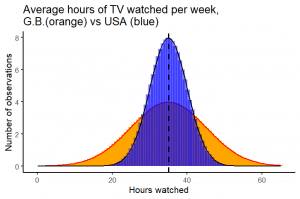
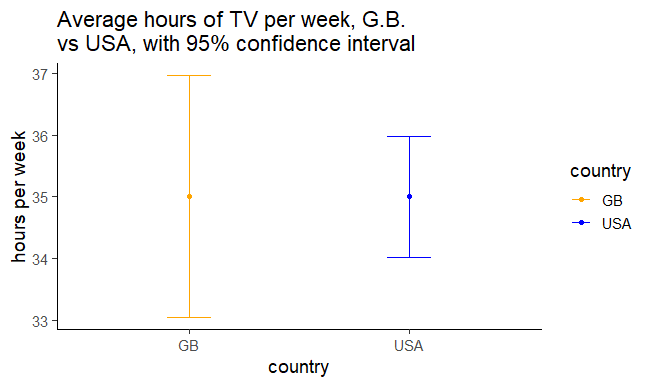
Withal, the British people surveyed had a wide variation in the number of hours watched, while the Americans all watched similar amounts.
Even though both groups have the aforementioned betoken estimate (boilerplate number of hours watched), the British estimate volition accept a wider confidence interval than the American approximate because there is more variation in the data.
Calculating a confidence interval: what you need to know
Most statistical programs will include the conviction interval of the guess when you run a statistical examination.
If you want to summate a confidence interval on your ain, you need to know:
- The point estimate you lot are constructing the confidence interval for
- The critical values for the test statistic
- The standard departure of the sample
- The sample size
Once you know each of these components, you can summate the confidence interval for your approximate by plugging them into the confidence interval formula that corresponds to your data.
Betoken estimate
The betoken gauge of your conviction interval will be whatever statistical estimate yous are making (e.g. population mean, the difference betwixt population means, proportions, variation among groups).
Finding the critical value
Critical values tell you lot how many standard deviations abroad from the hateful y'all need to become in order to reach the desired conviction level for your confidence interval.
There are 3 steps to find the disquisitional value.
- Choose your alpha ( a ) value.
The alpha value is the probability threshold for statistical significance. The most common alpha value is p = 0.05, but 0.1, 0.01, and even 0.001 are sometimes used. It's all-time to await at the papers published in your field to decide which alpha value to utilize.
- Decide if you need a 1-tailed interval or a two-tailed interval.
You will most probable utilise a two-tailed interval unless you are doing a i-tailed t-exam.
For a ii-tailed interval, divide your alpha by two to get the alpha value for the upper and lower tails.
- Await upward the critical value that corresponds with the alpha value.
If your information follows a normal distribution, or if yous have a large sample size (n > 30) that is approximately normally distributed, yous can use the z-distribution to find your critical values.
For a z-statistic, some of the well-nigh mutual values are shown in this table:
| Confidence level | 90% | 95% | 99% |
|---|---|---|---|
| alpha for one-tailed CI | 0.1 | 0.05 | 0.01 |
| blastoff for 2-tailed CI | 0.05 | 0.025 | 0.005 |
| z-statistic | 1.64 | i.96 | two.57 |
If you are using a small dataset (n ≤ 30) that is approximately normally distributed, utilise the t-distribution instead.
The t-distribution follows the same shape as the z-distribution, but corrects for small sample sizes. For the t-distribution, you need to know your degrees of liberty (sample size minus 1).
Check out this gear up of t tables to find your t-statistic. The author has included the conviction level and p-values for both one-tailed and two-tailed tests to help you discover the t-value you demand.
For normal distributions, similar the t-distribution and z-distribution, the critical value is the same on either side of the mean.
For a two-tailed 95% confidence interval, the alpha value is 0.025, and the corresponding critical value is 1.96.
This means that to calculate the upper and lower premises of the confidence interval, nosotros can take the mean ±1.96 standard deviations from the mean.
Finding the standard deviation
Most statistical software will have a built-in function to calculate your standard deviation, but to find information technology past hand yous can beginning observe your sample variance, then accept the square root to go the standard departure.
- Observe the sample variance
Sample variance is divers as the sum of squared differences from the mean, too known as the mean-squared-error (MSE):
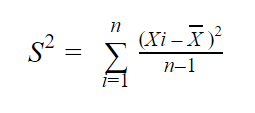
To discover the MSE, subtract your sample hateful from each value in the dataset, square the resulting number, and dissever that number by n − 1 (sample size minus ane).
Then add together upwardly all of these numbers to become your total sample variance (due south 2). For larger sample sets, it'southward easiest to do this in Excel.
- Find the standard deviation.
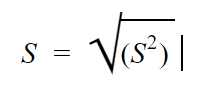
The standard divergence of your guess (south) is equal to the square root of the sample variance/sample mistake (due south 2):
- 10 for the GB gauge.
- 5 for the USA estimate.
Sample size
The sample size is the number of observations in your data set.
What is your plagiarism score?
Compare your paper with over 60 billion web pages and 30 one thousand thousand publications.
- Best plagiarism checker of 2021
- Plagiarism report & pct
- Largest plagiarism database
Scribbr Plagiarism Checker
Confidence interval for the mean of normally-distributed data
Unremarkably-distributed data forms a bong shape when plotted on a graph, with the sample hateful in the middle and the rest of the information distributed fairly evenly on either side of the mean.
The conviction interval for information which follows a standard normal distribution is:
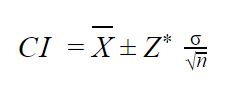
Where:
- CI = the confidence interval
- X̄ = the population mean
- Z* = the critical value of the z-distribution
- σ = the population standard deviation
- √n = the foursquare root of the population size
The conviction interval for the t-distribution follows the same formula, simply replaces the Z* with the t*.
In real life, you never know the true values for the population (unless you tin can do a complete census). Instead, we replace the population values with the values from our sample data, so the formula becomes:
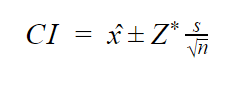
Where:
- ˆx = the sample hateful
- south = the sample standard departure
To calculate the 95% confidence interval, nosotros can just plug the values into the formula.
For the USA:
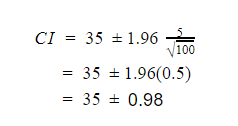
So for the USA, the lower and upper bounds of the 95% conviction interval are 34.02 and 35.98.
For GB:
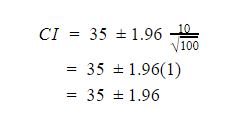
And so for the GB, the lower and upper premises of the 95% confidence interval are 33.04 and 36.96.
Confidence interval for proportions
The confidence interval for a proportion follows the same pattern as the confidence interval for ways, but place of the standard difference you utilize the sample proportion times one minus the proportion:
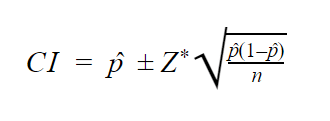
Where:
- ˆp = the proportion in your sample (e.g. the proportion of respondents who said they watched any television at all)
- Z*= the critical value of the z-distribution
- northward = the sample size
Conviction interval for not-normally distributed data
To summate a confidence interval around the mean of data that is not normally distributed, you have two choices:
- You can find a distribution that matches the shape of your data and use that distribution to calculate the conviction interval.
- You can perform a transformation on your data to make it fit a normal distribution, and so find the conviction interval for the transformed data.
Performing data transformations is very mutual in statistics, for case, when data follows a logarithmic curve only we want to use it alongside linear data. You merely take to recollect to do the contrary transformation on your data when you summate the upper and lower bounds of the confidence interval.
Reporting conviction intervals
Confidence intervals are sometimes reported in papers, though researchers more often report the standard deviation of their estimate.
If you are asked to written report the confidence interval, y'all should include the upper and lower premises of the confidence interval.
One place that confidence intervals are oftentimes used is in graphs. When showing the differences between groups, or plotting a linear regression, researchers will often include the confidence interval to give a visual representation of the variation effectually the estimate.
Circumspection when using confidence intervals
Confidence intervals are sometimes interpreted as saying that the 'true value' of your gauge lies inside the bounds of the confidence interval.
This is not the example. The confidence interval cannot tell you how likely it is that you constitute the truthful value of your statistical estimate because it is based on a sample, not on the whole population.
The confidence interval only tells yous what range of values you can expect to find if y'all re-do your sampling or run your experiment once more in the exact same way.
The more than accurate your sampling programme, or the more realistic your experiment, the greater the chance that your confidence interval includes the true value of your estimate. Only this accuracy is adamant by your research methods, not past the statistics yous do after you have collected the data!
Ofttimes asked questions about confidence intervals
- What is the departure betwixt a conviction interval and a confidence level?
-
The confidence level is the percent of times you expect to get close to the same estimate if you lot run your experiment again or resample the population in the same manner.
The confidence interval consists of the upper and lower bounds of the estimate you lot look to detect at a given level of confidence.
For example, if you lot are estimating a 95% conviction interval around the mean proportion of female person babies born every twelvemonth based on a random sample of babies, y'all might detect an upper leap of 0.56 and a lower jump of 0.48. These are the upper and lower bounds of the confidence interval. The confidence level is 95%.
This means that 95% of the calculated confidence intervals (for this sample) contains the truthful mean of the population.
- What are z-scores and t-scores?
-
The z-score and t-score (aka z-value and t-value) bear witness how many standard deviations away from the mean of the distribution you lot are, assuming your data follow a z-distribution or a t-distribution.
These scores are used in statistical tests to show how far from the hateful of the predicted distribution your statistical estimate is. If your examination produces a z-score of ii.5, this means that your gauge is 2.5 standard deviations from the predicted mean.
The predicted mean and distribution of your estimate are generated past the null hypothesis of the statistical examination yous are using. The more standard deviations away from the predicted mean your judge is, the less likely it is that the guess could have occurred under the null hypothesis.
- What is a critical value?
-
A disquisitional value is the value of the examination statistic which defines the upper and lower premises of a confidence interval, or which defines the threshold of statistical significance in a statistical examination. It describes how far from the mean of the distribution you take to go to encompass a certain amount of the total variation in the data (i.e. 90%, 95%, 99%).
If you are constructing a 95% confidence interval and are using a threshold of statistical significance of p = 0.05, then your critical value will be identical in both cases.
- What does it mean if my confidence interval includes nothing?
-
If your confidence interval for a difference between groups includes zero, that means that if you run your experiment once more you take a good hazard of finding no difference betwixt groups.
If your confidence interval for a correlation or regression includes cypher, that means that if you run your experiment again there is a good chance of finding no correlation in your data.
In both of these cases, you volition also detect a high p-value when you lot run your statistical test, meaning that your results could take occurred under the null hypothesis of no human relationship between variables or no difference between groups.
Is this commodity helpful?
You have already voted. Thanks :-) Your vote is saved :-) Processing your vote...
Source: https://www.scribbr.com/statistics/confidence-interval/
0 Response to "suppose you measure x to be (3.0 ± 0.1) and then calculate q=ex. what is q with its uncertainty?"
Publicar un comentario